
Heat Exchanger
A heat exchanger is a specialized device designed to efficiently transfer thermal energy between two or more fluids typically liquids or gases without allowing them to mix directly. This transfer occurs either through a solid separating wall (in indirect or recuperative types) or via direct contact in specific designs. Heat exchangers are fundamental to countless industrial, commercial, and everyday processes, enabling energy recovery, temperature control, and process optimization while minimizing waste.
Key heat transfer mechanisms involved:
Convection — Primary on fluid sides (enhanced by turbulence, velocity, and surface features like corrugations or fins).
Conduction — Through the wall material.
Radiation — Usually negligible unless at very high temperatures.
Heat Exchanger Services
Fusion Engitech offers comprehensive heat exchanger services designed to improve operational efficiency, thermal performance, and equipment life in industrial plants. The company operates in maintenance, and facility management with a strong focus on engineering excellence and client sat
Our Key Services Include
Inspection & Diagnostics
I) Performance evaluation of heat exchangers.
II) Leak detection and thermal efficiency analysis.
III) Identification of fouling, corrosion, and scaling issues.
Cleaning & Maintenance
I) Mechanical and chemical cleaning of tubes and plates
II) Descaling and removal of deposits
III) Preventive and breakdown maintenance services
Repair & Refurbishment
I) Tube replacement and plugging
II) Gasket replacement for plate heat exchangers
III) Shell repairs, welding, and structural restoration
Installation & Commissioning
I) Erection and alignment of heat exchangers
II) Hydro testing and performance validation
III) On-site commissioning support
Fabrication & Custom Solutions
I) Manufacturing of shell & tube heat exchangers
II) Custom-designed thermal systems based on client requirements III) Compliance with industry standards (ASME, TEMA, IS, DIN)
Types of Heat Exchangers Handled
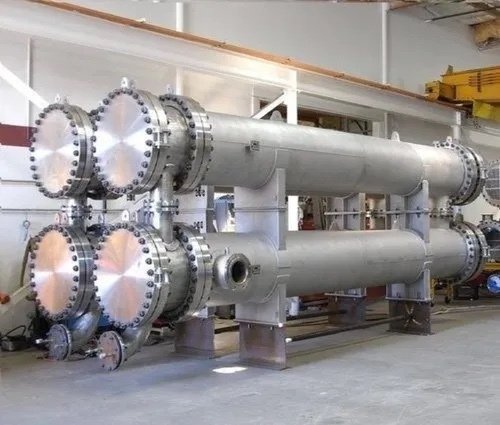
Shell & Tube Heat Exchangers
Shell & Tube Heat Exchangers are the most widely used thermal devices in heavy industries due to their robust construction and versatility. They consist of a bundle of tubes enclosed within a cylindrical shell. One fluid flows through the tubes (tube-side), while the other flows across the tubes within the shell (shell-side).
These exchangers are designed to handle high pressure, high temperature, and large flow rates, making them ideal for applications in power plants, oil refineries, and chemical processing units. Their design allows for easy maintenance, tube replacement, and mechanical cleaning. Advanced configurations include multi-pass arrangements, baffles for turbulence enhancement, and floating head designs to accommodate thermal expansion.
Plate Heat Exchangers (PHE)
Plate Heat Exchangers utilize a series of corrugated metal plates arranged in a stack, forming multiple channels for fluid flow. The fluids pass through alternate channels, enabling efficient heat transfer through the thin plate surfaces.
PHEs offer high thermal efficiency due to increased surface area and turbulence, making them significantly more compact than shell & tube exchangers. They are commonly used in HVAC systems, food processing, pharmaceuticals, and low-to-medium pressure applications. Their modular design allows easy expansion and maintenance, although they are generally less suitable for extremely high-pressure or highly fouling environments.
Air Cooled Heat Exchangers
Air Cooled Heat Exchangers (ACHE) use ambient air as the cooling medium instead of water. They consist of finned tubes over which air is forced (via fans) or drawn to remove heat from the process fluid flowing inside the tubes.
These exchangers are particularly valuable in locations where water is scarce or expensive, such as remote industrial sites and refineries. They eliminate the need for cooling towers and water treatment systems. However, their performance is influenced by ambient air temperature and environmental conditions, and they typically require larger installation space compared to water-cooled systems.
Condensers & Coolers
Condensers and coolers are specialized heat exchangers designed for phase change and temperature reduction processes.
- Condensers convert vapors into liquids by removing latent heat. They are widely used in power plants (steam condensation), refrigeration systems, and chemical industries.
- Coolers are used to lower the temperature of fluids without phase change, ensuring safe and efficient operation of machinery and processes.
These units can be designed in various forms, including shell & tube, air-cooled, or plate-type configurations, depending on the application. Efficient design ensures optimal heat removal while minimizing pressure drop and energy consumption.
Gas-to-Gas Heaters (FGD Systems)
Gas-to-Gas Heaters (GGH) are specialized heat exchangers used primarily in Flue Gas Desulfurization (FGD) systems in power plants and industrial emission control units. Their main function is to transfer heat between hot untreated flue gas and cooler treated gas streams.
By reheating the cleaned flue gas before it is released into the atmosphere, GGH systems help:
- Prevent condensation and corrosion in chimneys
- Improve plume dispersion
- Enhance overall system efficiency
These exchangers are typically constructed using corrosion-resistant materials due to exposure to acidic gases and harsh operating conditions. Common designs include rotary regenerative heaters and tubular heat exchangers.
Industries Served
Oil & Gas & Refineries
Petrochemical & Chemical Plants
Power Generation (Thermal & Gas Plants)
Fertilizer Industry
Pharmaceuticals
Food & Beverage Processing
Steel & Metal Industry
HVAC & Refrigeration Systems
Why Choose Us
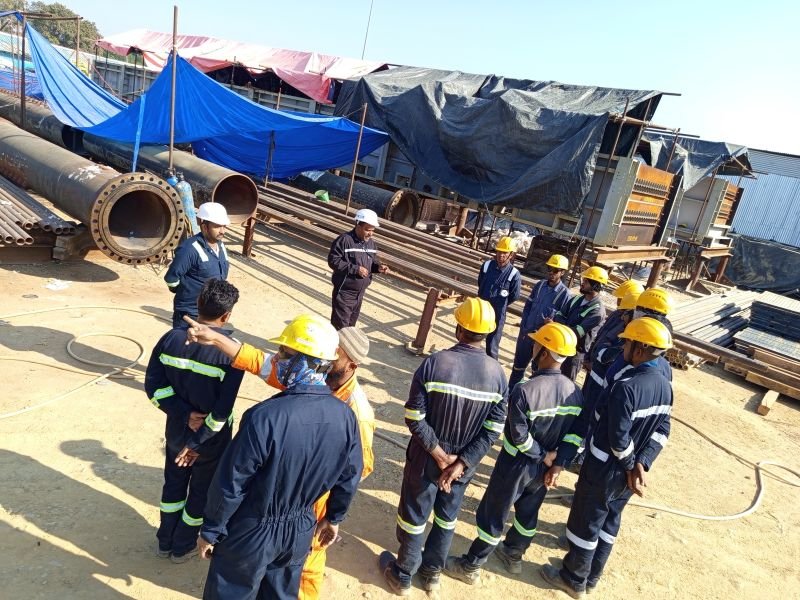
Experienced & Skilled Team
Industry-Specific Solutions
Advanced Tools & Techniques
Strict EHS Compliance
Fast Turnaround Time
Cost-Effective & Reliable Services